
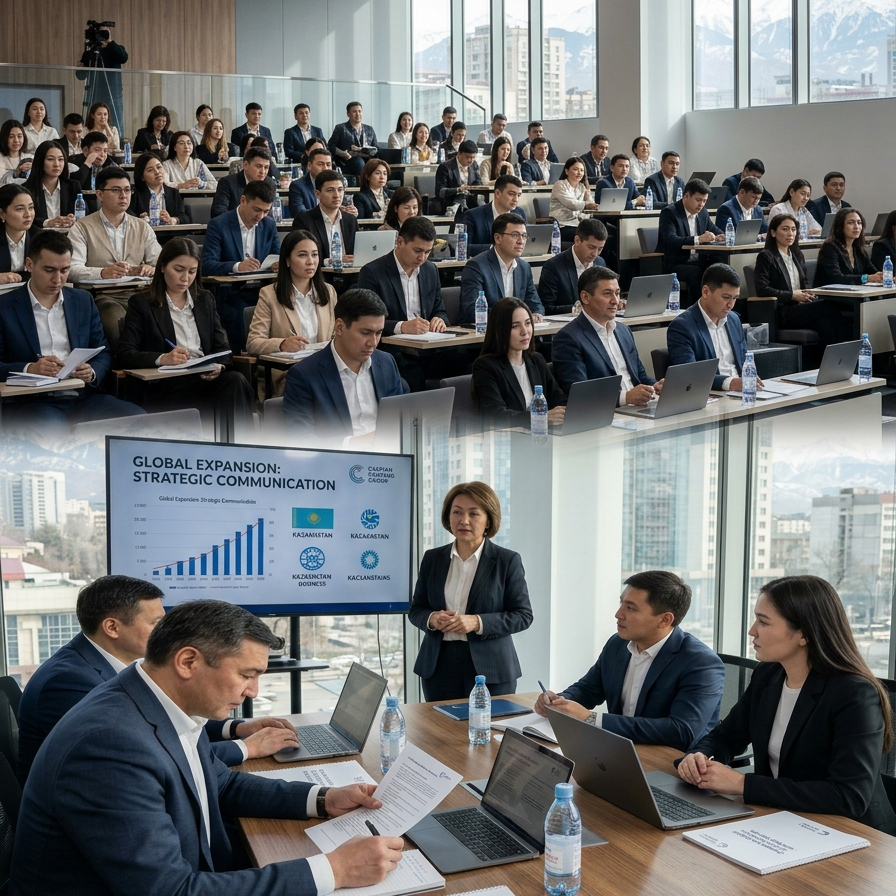
The Language Barrier as a Ceiling for Kazakhstan’s Business Ambitions
The era of "regional dominance" is hitting a hard wall. For years, major players in Almaty and Astana focused on domestic market capture, navigating local regulations, and securing market share within the CIS. But the 2026 economic landscape in Kazakhstan has shifted. Whether you are an IT firm scaling out of Astana Hub or a logistics giant streamlining Middle Corridor operations, the limitation is no longer capital or logistics—it is the communication bottleneck.
Let’s be blunt: a CEO who relies on a translator during a high-stakes negotiation in Dubai or London is at a massive disadvantage. Information is lost. Subtext is missed. Trust, the currency of global trade, evaporates when you cannot defend your margins or articulate your USP in real-time. We have audited dozens of Kazakhstani companies where mid-level management—brilliant engineers and financiers—possess high "grades" on paper but freeze during a cross-border Zoom call. This "silent" workforce is a liability.
When your team struggles to differentiate between a "binding agreement" and a "letter of intent," or fails to navigate a tense Q&A session with European investors, you aren't just facing a language issue. You are facing a revenue leak. The ambition to scale beyond our borders requires more than just a digital product or a raw commodity; it requires a workforce that can project authority. Without a robust corporate english course that targets functional fluency, your international expansion isn't a strategy—it’s a gamble. At Caspian Training Group, we’ve seen how local firms struggle to move from "survival mode" to "global leadership" simply because their communication doesn't match their technical expertise.
The goal here isn't just "learning English." It’s about removing the ceiling. It’s about ensuring that when a Kazakhstani brand enters a new territory, they aren't viewed as a "local provider," but as a peer.
Strategic Alignment: Moving from General ESL to Targeted Corporate English
Standard English schools are designed for students, tourists, and hobbyists. They focus on grammar charts and "London is the capital of Great Britain." In the boardroom, that approach is useless. To scale globally, your training must be surgically aligned with your specific business vertical. This is where most HR directors in Kazakhstan make a critical mistake: they buy "General English" packages for a "Business English" problem.
We have refined a methodology that replaces generic storytelling with high-intensity, functional training. If your team is in Fintech, why are they spending time learning about travel vocabulary? They should be mastering the terminology of "liquidity ratios," "decentralized finance," and "regulatory compliance."
Industry-Specific Vocabulary
A one-size-fits-all approach is a waste of your training budget. We customize every corporate english course to the specific DNA of the client. For a manufacturing plant in Karaganda, the focus is on supply chain management, safety protocols, and international procurement. For an Almaty-based creative agency, the focus shifts to pitching, storytelling, and emotional intelligence in branding.
We strip away the "fluff." We focus on the "meat." Every hour of training must correlate to a task the employee performs at their desk. If the training doesn't help them write a better report or close a ticket faster, it doesn't belong in our curriculum.
Business Etiquette and Cultural Nuances
Scaling beyond KZ means understanding that business logic varies by geography. A "yes" in Almaty might mean "we are considering it," while a "yes" in New York is a commitment. Our programs go beyond the dictionary. We train your "кадровый резерв" (talent pool) to navigate the subtle nuances of Western and Asian business cultures.
Expert Insight: If you’re ready to stop wasting time on "school-style" lessons and want a diagnostic audit of your team’s real-world capabilities, contact us. We don't just teach; we integrate communication into your growth strategy.
Maximizing ROI: Why Skill-Based Language Training is a Financial Asset
For a CFO in Almaty or a business owner in Shymkent, every tenge spent on "soft skills" is scrutinized. The common skepticism is understandable: why pay for English if the employee might leave for a competitor in six months? At Caspian Training Group, we flip the script. We view a corporate english course not as a luxury benefit, but as a hard financial asset that directly impacts your bottom line. If your "кадровый резерв" cannot defend a price increase to a European distributor because they lack the vocabulary for "inflationary adjustments" or "logistical overhead," you are losing money every single day.
Reducing Lead Response Time
Efficiency is the first victim of a language barrier. When an inquiry hits the CRM from a potential partner in Southeast Asia or the Baltics, how long does it take your sales team to draft a professional, error-free response? In many Kazakhstani firms, a simple email goes through three layers of internal "checks" or, worse, a clunky translation process. This friction kills deals. By implementing targeted training, we eliminate this lag. Your team gains the autonomy to respond instantly, with the correct tone and technical precision. Speed is a competitive advantage; language proficiency is the engine.
Improving Conversion in Sales Pitches
Winning a tender isn't just about having the lowest price; it’s about perceived reliability. When your project managers present a proposal via Zoom, their level of English dictates the client's perception of your company's competence. A stuttering, unclear pitch creates "transactional risk" in the mind of the buyer. We focus on the "meat" of the pitch—drilling the specific phrases that project authority and handle objections. When your team can navigate a "grilling" session from a foreign procurement board without breaking a sweat, your conversion rates climb. That is the true measure of ROI.
The "Almaty to the World" Roadmap: Training Management for Global Leadership
The "glass ceiling" often starts at the top. We have personally curated training for executives in Almaty’s largest holding companies, and the pattern is consistent: top-tier technical and leadership skills, but a reliance on "silent" participation in international forums. For a company to scale beyond the borders of Kazakhstan, the leadership must be the face of the brand. You cannot lead a global expansion from behind a translator’s shoulder.
The "Almaty to the World" roadmap is about shifting the mindset of your C-suite and middle management from "local experts" to "global leaders." This transition requires a specific type of linguistic confidence that goes beyond mere "fluency."
Preparation for International Forums and Roadshows
Kazakhstan is increasingly visible on the global stage—from AEF to international industry expos in Frankfurt or Dubai. If your Directors are attending these events only to collect brochures because they aren't comfortable networking in English, you are wasting your travel budget. Our intensive tracks for management focus on "Socializing for Business." We teach the art of the 30-second elevator pitch, the nuances of small talk that leads to big contracts, and the ability to chair a meeting with diverse stakeholders.
Direct Communication: Cutting the Middleman
Relying on translators is not just slow; it’s dangerous. Nuance is the first thing to disappear in translation. A translator might understand the words, but do they understand your margin strategy? Do they understand the technical limitations of your software? By training your leadership to communicate directly, you ensure that your strategic intent remains 100% intact.
In our work at Caspian Training Group, we’ve seen the transformative power of a CEO who can speak directly to an investor. It changes the power dynamic. It moves the relationship from "client-vendor" to "strategic partners." This is how you future-proof your leadership team and ensure that your expansion into foreign markets is led by your best people, not just your best linguists.
Decision-Maker’s Note: Training your top tier is the highest-leverage move you can make. If your leadership speaks the language of the global market, the rest of the company will follow. Let us help you map out a leadership communication strategy that actually sticks.
Integration with Kazakhstan’s Digital Transformation (Astana Hub & Beyond)
Kazakhstan is no longer just a "resource economy." With the aggressive growth of the Astana Hub and the digitalization of the AIFC (MFCA), Almaty and Astana have become breeding grounds for high-growth tech and fintech players. However, digital transformation is a hollow shell if your human capital is locked out of the global ecosystem. In the tech world, English is the "operating system." If your developers, product owners, and architects can’t navigate it, your software stays local.
Hybrid Learning for Remote Teams
The post-pandemic business model in Kazakhstan has shifted. Large corporations now have distributed teams across Shymkent, Karaganda, and Aktau. We recognized early on that a physical classroom in a single Almaty office is no longer a scalable solution. At Caspian Training Group, we’ve perfected a hybrid delivery model that ensures consistency across the board.
We don't just "put people on a call." We synchronize the curriculum so that a Junior Dev in Oskemen and a Senior Manager in the capital are moving at the same pace, using the same "business-lingua." This unified approach ensures that internal "кадровый резерв" (talent pool) movements are seamless. When everyone speaks the same professional language, regional silos vanish, and the company starts moving as a single, coordinated unit.
English for Tech Documentation and Support
For our partners scaling software products, the challenge is often the "support gap." It’s one thing to write code; it’s another to provide high-level technical support to a client in Singapore or Germany. A specialized corporate english course for tech teams focuses on:
Talent Retention: Building a Global Corporate Culture in Local Companies
In the current Kazakhstan labor market, "удержание" (retention) is a nightmare for HR Directors. The "brain drain" is real—top-tier talent is constantly being scouted by international giants. To keep your best people, you have to offer more than just a competitive "грейд" (grade) and a gym membership. You need to offer a career trajectory that feels global.
Building an Internal "Learning Organization"
When a company invests in a high-quality corporate english course, it sends a powerful message to the staff: "We are preparing you for the world stage." This is a massive "софт" (soft skill) benefit that increases loyalty. At Caspian Training Group, we’ve observed that employees who feel their global market value is increasing within their current company are 40% less likely to entertain offers from competitors. You aren't just teaching them English; you are upgrading their professional identity.
Creating a "Borderless" Mindset
Cultural integration is the secret sauce of global scaling. By fostering an environment where English is part of the professional DNA, you break the "local mindset." Employees start reading international industry news, following global trends, and bringing world-class ideas back into your Almaty boardroom.
Expert Take: If your HR strategy doesn't include a clear path for linguistic upskilling, you are likely losing your "A-players" to companies that do. Let's discuss how to build a retention-focused training program that keeps your best talent right where they belong—in your team.
Avoiding Common Pitfalls in Corporate Language Programs
Having personally managed large-scale training deployments for industrial and financial giants across Almaty, we have identified a recurring pattern of failure in standard programs. Most companies treat language training as a "check-the-box" HR exercise rather than a strategic integration. This leads to what we call "training fatigue"—where employees attend classes for months without any measurable improvement in their job performance.
The "One-Size-Fits-All" Trap
The most frequent mistake is purchasing a generic curriculum. If your logistics managers are studying the same material as your administrative staff, you are diluting the impact of your investment. At Caspian Training Group, we believe in surgery, not generalities. A corporate english course must be preceded by a deep-dive "Needs Analysis." This means interviewing department heads to understand if the priority is writing technical documentation, defending a budget, or managing an international supply chain. Without this alignment, you are essentially paying for a hobby, not a business tool.
Neglecting the "Entrance Audit"
Many firms in Kazakhstan skip a rigorous entry assessment to save time. They group employees by vague "intermediate" or "advanced" levels based on self-reporting. This is a recipe for disaster. Effective groups must be formed not just by level, but by professional function and learning speed. We insist on a multi-stage audit—testing grammar, speaking confidence, and listening comprehension—before a single lesson begins. This ensures that the high-performers (your "кадровый резерв") aren't held back by those who need more fundamental support.
Lack of Continuous Accountability
Training isn't a "set and forget" activity. Without transparent reporting and mid-term assessments, motivation inevitably drops. We have seen programs lose 50% of their attendance within three months because there was no linkage between the classroom and the employee’s "грейд" (grade) or performance review. Success requires a partnership between the provider and your HR team to ensure that progress is tracked, reported, and rewarded.
Future-Proofing Your Business: The 2026 Competitive Edge
As we look toward the remainder of 2026 and into 2027, the "wait and see" approach to internationalization is no longer viable. The Kazakhstani market is integrating with global networks at an unprecedented speed. From the expansion of the "Middle Corridor" logistics route to the influx of international investment in Almaty's tech scene, the language of the game is English.
English as a Hygiene Factor, Not a Perk
In the very near future, professional-grade English will be a "hygiene factor"—a basic requirement for doing business, much like having a stable internet connection. Companies that act now are building a "competitive moat." While your rivals are still struggling with basic translations, your team could already be deep into strategic partnerships in markets you haven't even entered yet.
The Cost of Inaction
The cost of a corporate english course is a fraction of the cost of one failed international contract. Think of the missed opportunities: the tender you didn't bid on because the documentation was too complex, or the foreign partner who chose a competitor because their communication felt more "seamless." In the global arena, silence is interpreted as incompetence.
Final Call to Action: Start Your Audit Today
The path to scaling beyond Kazakhstan begins with a clear-eyed assessment of your current team’s capabilities. Don't wait for a crisis or a lost deal to realize you have a communication gap.
At Caspian Training Group, we don't just provide lessons; we provide a bridge to the global market. Our experience in the local trenches of Almaty and beyond gives us the unique perspective needed to transform your workforce from a local team into a global powerhouse. Let's move beyond the borders of KZ together. Your international growth depends on the words your team uses today.
Ready to Scale? Contact us for a comprehensive diagnostic audit of your team's business communication skills. Let's turn your language proficiency into your strongest competitive advantage.
The era of "regional dominance" is hitting a hard wall. For years, major players in Almaty and Astana focused on domestic market capture, navigating local regulations, and securing market share within the CIS. But the 2026 economic landscape in Kazakhstan has shifted. Whether you are an IT firm scaling out of Astana Hub or a logistics giant streamlining Middle Corridor operations, the limitation is no longer capital or logistics—it is the communication bottleneck.
Let’s be blunt: a CEO who relies on a translator during a high-stakes negotiation in Dubai or London is at a massive disadvantage. Information is lost. Subtext is missed. Trust, the currency of global trade, evaporates when you cannot defend your margins or articulate your USP in real-time. We have audited dozens of Kazakhstani companies where mid-level management—brilliant engineers and financiers—possess high "grades" on paper but freeze during a cross-border Zoom call. This "silent" workforce is a liability.
When your team struggles to differentiate between a "binding agreement" and a "letter of intent," or fails to navigate a tense Q&A session with European investors, you aren't just facing a language issue. You are facing a revenue leak. The ambition to scale beyond our borders requires more than just a digital product or a raw commodity; it requires a workforce that can project authority. Without a robust corporate english course that targets functional fluency, your international expansion isn't a strategy—it’s a gamble. At Caspian Training Group, we’ve seen how local firms struggle to move from "survival mode" to "global leadership" simply because their communication doesn't match their technical expertise.
The goal here isn't just "learning English." It’s about removing the ceiling. It’s about ensuring that when a Kazakhstani brand enters a new territory, they aren't viewed as a "local provider," but as a peer.
Strategic Alignment: Moving from General ESL to Targeted Corporate English
Standard English schools are designed for students, tourists, and hobbyists. They focus on grammar charts and "London is the capital of Great Britain." In the boardroom, that approach is useless. To scale globally, your training must be surgically aligned with your specific business vertical. This is where most HR directors in Kazakhstan make a critical mistake: they buy "General English" packages for a "Business English" problem.
We have refined a methodology that replaces generic storytelling with high-intensity, functional training. If your team is in Fintech, why are they spending time learning about travel vocabulary? They should be mastering the terminology of "liquidity ratios," "decentralized finance," and "regulatory compliance."
Industry-Specific Vocabulary
A one-size-fits-all approach is a waste of your training budget. We customize every corporate english course to the specific DNA of the client. For a manufacturing plant in Karaganda, the focus is on supply chain management, safety protocols, and international procurement. For an Almaty-based creative agency, the focus shifts to pitching, storytelling, and emotional intelligence in branding.
We strip away the "fluff." We focus on the "meat." Every hour of training must correlate to a task the employee performs at their desk. If the training doesn't help them write a better report or close a ticket faster, it doesn't belong in our curriculum.
Business Etiquette and Cultural Nuances
Scaling beyond KZ means understanding that business logic varies by geography. A "yes" in Almaty might mean "we are considering it," while a "yes" in New York is a commitment. Our programs go beyond the dictionary. We train your "кадровый резерв" (talent pool) to navigate the subtle nuances of Western and Asian business cultures.
- Email Diplomacy: How to push back on a deadline without sounding aggressive.
- Negotiation Dynamics: How to use "hedging" and "modal verbs" to sound professional rather than blunt.
- Soft Skills: Managing a team across different time zones and cultural backgrounds.
Expert Insight: If you’re ready to stop wasting time on "school-style" lessons and want a diagnostic audit of your team’s real-world capabilities, contact us. We don't just teach; we integrate communication into your growth strategy.
Maximizing ROI: Why Skill-Based Language Training is a Financial Asset
For a CFO in Almaty or a business owner in Shymkent, every tenge spent on "soft skills" is scrutinized. The common skepticism is understandable: why pay for English if the employee might leave for a competitor in six months? At Caspian Training Group, we flip the script. We view a corporate english course not as a luxury benefit, but as a hard financial asset that directly impacts your bottom line. If your "кадровый резерв" cannot defend a price increase to a European distributor because they lack the vocabulary for "inflationary adjustments" or "logistical overhead," you are losing money every single day.
Reducing Lead Response Time
Efficiency is the first victim of a language barrier. When an inquiry hits the CRM from a potential partner in Southeast Asia or the Baltics, how long does it take your sales team to draft a professional, error-free response? In many Kazakhstani firms, a simple email goes through three layers of internal "checks" or, worse, a clunky translation process. This friction kills deals. By implementing targeted training, we eliminate this lag. Your team gains the autonomy to respond instantly, with the correct tone and technical precision. Speed is a competitive advantage; language proficiency is the engine.
Improving Conversion in Sales Pitches
Winning a tender isn't just about having the lowest price; it’s about perceived reliability. When your project managers present a proposal via Zoom, their level of English dictates the client's perception of your company's competence. A stuttering, unclear pitch creates "transactional risk" in the mind of the buyer. We focus on the "meat" of the pitch—drilling the specific phrases that project authority and handle objections. When your team can navigate a "grilling" session from a foreign procurement board without breaking a sweat, your conversion rates climb. That is the true measure of ROI.
The "Almaty to the World" Roadmap: Training Management for Global Leadership
The "glass ceiling" often starts at the top. We have personally curated training for executives in Almaty’s largest holding companies, and the pattern is consistent: top-tier technical and leadership skills, but a reliance on "silent" participation in international forums. For a company to scale beyond the borders of Kazakhstan, the leadership must be the face of the brand. You cannot lead a global expansion from behind a translator’s shoulder.
The "Almaty to the World" roadmap is about shifting the mindset of your C-suite and middle management from "local experts" to "global leaders." This transition requires a specific type of linguistic confidence that goes beyond mere "fluency."
Preparation for International Forums and Roadshows
Kazakhstan is increasingly visible on the global stage—from AEF to international industry expos in Frankfurt or Dubai. If your Directors are attending these events only to collect brochures because they aren't comfortable networking in English, you are wasting your travel budget. Our intensive tracks for management focus on "Socializing for Business." We teach the art of the 30-second elevator pitch, the nuances of small talk that leads to big contracts, and the ability to chair a meeting with diverse stakeholders.
Direct Communication: Cutting the Middleman
Relying on translators is not just slow; it’s dangerous. Nuance is the first thing to disappear in translation. A translator might understand the words, but do they understand your margin strategy? Do they understand the technical limitations of your software? By training your leadership to communicate directly, you ensure that your strategic intent remains 100% intact.
In our work at Caspian Training Group, we’ve seen the transformative power of a CEO who can speak directly to an investor. It changes the power dynamic. It moves the relationship from "client-vendor" to "strategic partners." This is how you future-proof your leadership team and ensure that your expansion into foreign markets is led by your best people, not just your best linguists.
Decision-Maker’s Note: Training your top tier is the highest-leverage move you can make. If your leadership speaks the language of the global market, the rest of the company will follow. Let us help you map out a leadership communication strategy that actually sticks.
Integration with Kazakhstan’s Digital Transformation (Astana Hub & Beyond)
Kazakhstan is no longer just a "resource economy." With the aggressive growth of the Astana Hub and the digitalization of the AIFC (MFCA), Almaty and Astana have become breeding grounds for high-growth tech and fintech players. However, digital transformation is a hollow shell if your human capital is locked out of the global ecosystem. In the tech world, English is the "operating system." If your developers, product owners, and architects can’t navigate it, your software stays local.
Hybrid Learning for Remote Teams
The post-pandemic business model in Kazakhstan has shifted. Large corporations now have distributed teams across Shymkent, Karaganda, and Aktau. We recognized early on that a physical classroom in a single Almaty office is no longer a scalable solution. At Caspian Training Group, we’ve perfected a hybrid delivery model that ensures consistency across the board.
We don't just "put people on a call." We synchronize the curriculum so that a Junior Dev in Oskemen and a Senior Manager in the capital are moving at the same pace, using the same "business-lingua." This unified approach ensures that internal "кадровый резерв" (talent pool) movements are seamless. When everyone speaks the same professional language, regional silos vanish, and the company starts moving as a single, coordinated unit.
English for Tech Documentation and Support
For our partners scaling software products, the challenge is often the "support gap." It’s one thing to write code; it’s another to provide high-level technical support to a client in Singapore or Germany. A specialized corporate english course for tech teams focuses on:
- Documentation: Writing clear, concise API docs and user manuals.
- Troubleshooting: Managing high-pressure support tickets with professional empathy and technical precision.
- Agile Communication: Participating in "daily stand-ups" or "sprint reviews" with international stakeholders.
Talent Retention: Building a Global Corporate Culture in Local Companies
In the current Kazakhstan labor market, "удержание" (retention) is a nightmare for HR Directors. The "brain drain" is real—top-tier talent is constantly being scouted by international giants. To keep your best people, you have to offer more than just a competitive "грейд" (grade) and a gym membership. You need to offer a career trajectory that feels global.
Building an Internal "Learning Organization"
When a company invests in a high-quality corporate english course, it sends a powerful message to the staff: "We are preparing you for the world stage." This is a massive "софт" (soft skill) benefit that increases loyalty. At Caspian Training Group, we’ve observed that employees who feel their global market value is increasing within their current company are 40% less likely to entertain offers from competitors. You aren't just teaching them English; you are upgrading their professional identity.
Creating a "Borderless" Mindset
Cultural integration is the secret sauce of global scaling. By fostering an environment where English is part of the professional DNA, you break the "local mindset." Employees start reading international industry news, following global trends, and bringing world-class ideas back into your Almaty boardroom.
- Peer-to-Peer Learning: We encourage "English-only" hours or internal "Lunch & Learn" sessions where employees present their work in English.
- Professional Pride: There is a specific psychological shift when a team member successfully completes a negotiation with a foreign partner without an intermediary. That confidence becomes contagious.
Expert Take: If your HR strategy doesn't include a clear path for linguistic upskilling, you are likely losing your "A-players" to companies that do. Let's discuss how to build a retention-focused training program that keeps your best talent right where they belong—in your team.
Avoiding Common Pitfalls in Corporate Language Programs
Having personally managed large-scale training deployments for industrial and financial giants across Almaty, we have identified a recurring pattern of failure in standard programs. Most companies treat language training as a "check-the-box" HR exercise rather than a strategic integration. This leads to what we call "training fatigue"—where employees attend classes for months without any measurable improvement in their job performance.
The "One-Size-Fits-All" Trap
The most frequent mistake is purchasing a generic curriculum. If your logistics managers are studying the same material as your administrative staff, you are diluting the impact of your investment. At Caspian Training Group, we believe in surgery, not generalities. A corporate english course must be preceded by a deep-dive "Needs Analysis." This means interviewing department heads to understand if the priority is writing technical documentation, defending a budget, or managing an international supply chain. Without this alignment, you are essentially paying for a hobby, not a business tool.
Neglecting the "Entrance Audit"
Many firms in Kazakhstan skip a rigorous entry assessment to save time. They group employees by vague "intermediate" or "advanced" levels based on self-reporting. This is a recipe for disaster. Effective groups must be formed not just by level, but by professional function and learning speed. We insist on a multi-stage audit—testing grammar, speaking confidence, and listening comprehension—before a single lesson begins. This ensures that the high-performers (your "кадровый резерв") aren't held back by those who need more fundamental support.
Lack of Continuous Accountability
Training isn't a "set and forget" activity. Without transparent reporting and mid-term assessments, motivation inevitably drops. We have seen programs lose 50% of their attendance within three months because there was no linkage between the classroom and the employee’s "грейд" (grade) or performance review. Success requires a partnership between the provider and your HR team to ensure that progress is tracked, reported, and rewarded.
Future-Proofing Your Business: The 2026 Competitive Edge
As we look toward the remainder of 2026 and into 2027, the "wait and see" approach to internationalization is no longer viable. The Kazakhstani market is integrating with global networks at an unprecedented speed. From the expansion of the "Middle Corridor" logistics route to the influx of international investment in Almaty's tech scene, the language of the game is English.
English as a Hygiene Factor, Not a Perk
In the very near future, professional-grade English will be a "hygiene factor"—a basic requirement for doing business, much like having a stable internet connection. Companies that act now are building a "competitive moat." While your rivals are still struggling with basic translations, your team could already be deep into strategic partnerships in markets you haven't even entered yet.
The Cost of Inaction
The cost of a corporate english course is a fraction of the cost of one failed international contract. Think of the missed opportunities: the tender you didn't bid on because the documentation was too complex, or the foreign partner who chose a competitor because their communication felt more "seamless." In the global arena, silence is interpreted as incompetence.
Final Call to Action: Start Your Audit Today
The path to scaling beyond Kazakhstan begins with a clear-eyed assessment of your current team’s capabilities. Don't wait for a crisis or a lost deal to realize you have a communication gap.
At Caspian Training Group, we don't just provide lessons; we provide a bridge to the global market. Our experience in the local trenches of Almaty and beyond gives us the unique perspective needed to transform your workforce from a local team into a global powerhouse. Let's move beyond the borders of KZ together. Your international growth depends on the words your team uses today.
Ready to Scale? Contact us for a comprehensive diagnostic audit of your team's business communication skills. Let's turn your language proficiency into your strongest competitive advantage.